


2026 - 2027 AGE GROUP CHANGE INFORMATION
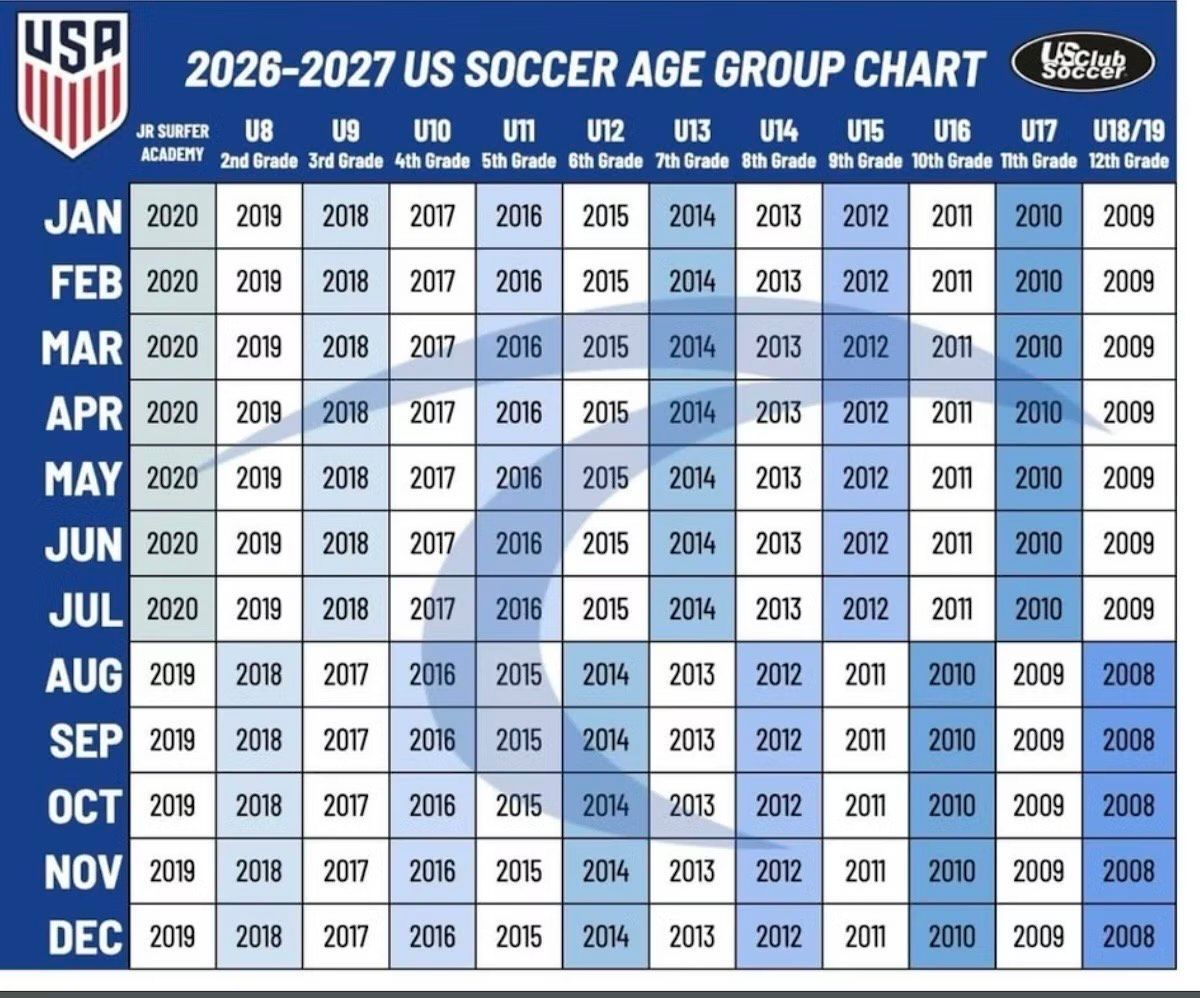
Frequently Asked Questions
-
Q: Does only birthdate get taken into consideration? Or does actual school year/grade also matter?List Item 1
A: U.S. Youth Soccer is mandating that all clubs shift from the current birth year (January–December) team formation model to a school year (August 1–July 31) birth date model. The player’s birth date is the deciding factor. Neither the player’s actual grade, nor Utah’s slightly different school-year model that starts Sept 1, is taken into consideration. Teams will be organized using the new August–July school-year groupings.
-
Q: Will all players be required to play strictly within their designated age group (even August birthdays), or what factors will be considered during placements for playing up?List Item 2
A: The majority of PCSC players will play within their age group because this aligns with their developmental needs. However, we recognize that in certain cases, providing opportunities for a player to train or compete in an older age group may be appropriate for their development. Many factors will be taken into consideration during placements, including technical and physical ability, cognitive and psychological well-being, social and emotional maturity, and player commitment and dedication. Any decision regarding playing up will be made at the discretion of the Technical Director, the associated Director of Coaching, and the coach/coaches who evaluate the players during Player Placements and throughout the season. Our staff will work closely with families to ensure each player is placed in the most appropriate and positive development environment. The detailed PCSC play-up policy can be found Here.
-
Q: Will there be efforts made to keep existing groups of players together, especially for the older teams that have been playing on the same teams for several years? Will Red vs White/Silver teams be treated differently?List Item 3
A: The club will do a thorough review of each age group to determine the best developmental path forward for each individual player and teams as a whole. In certain cases, it might be a better developmental fit for the majority of a team to stay together, rather than break apart. This will be determined on a case-by-case basis by the Technical Director, Director of Coaching, and coaches associated with the age group.
-
Q: How will placements work? Will players be allowed to try out for multiple age groups?List Item 4
A: Players will be permitted to try out for multiple age groups, but must have the permission of the Technical Director and associated Director of Coaching beforehand.
-
Q: Will the club pay attention to changes in the number of field players (7 to 9 players or 9 to 11 players) that some teams/players will experience? Specifically the implications of roster size and space.
A: The club will do a thorough review of each age group to determine the best developmental path forward for each player and teams as a whole. Each age group has unique circumstances as there are varying amounts of players in the age group, players aging up vs. aging down, teams moving to 9v9/11v11 which changes rosters sizes, etc. All of these factors will be taken into account when determining the best path forward for each group.
-
Q: What about players in their second year of Foundations (specifically those born in early 2018)? They’ll now be competing to get on a team during tryouts with players in their grade level (born Aug - Dec 2017) that have played much more competitively. How will you address this disadvantage?
A: This will happen to a certain extent for every age group in the club. In this particular case, the tactical, technical, physical, and social aspects learned from being in the Foundations Program should prepare players to compete in the newly formed age groups.
-
Q: Will U8 be in the competitive league or in Foundations for another year? If U8 is Foundations, would the Club consider taking on an additional U9 team (developmental) of the older U8 players, who would have moved up under the former structure?
A: All considerations are on the table to find the right fit for each player and team from a developmental standpoint. In some cases, it could be a good fit to move more players up to U9, while for others it might be a good fit to stay in Foundations for another year so they can gain the skills necessary to compete at U9 in the future.
-
Q: Will the club use this age shift to clarify the goals of various teams? E.g., Are Red teams meant to be an elite with greater commitment of time and desire to be competitive vs. white is more of a Rec+/Competitive?
A: The club’s vision is to provide multiple pathways for our members when possible. Each age group/gender has unique considerations when it comes to the number of players, developmental level, roster size, etc. What might be appropriate goals for one Red team, might not be a good fit for every Red team across the club. As such, the goals and aspirations for each team (Red, White, etc.) are set at the beginning of each cycle by the coach and director associated with each team.
-
Q: Will the club use this reorg to explore ECNL/ ECNL RL/ Girls Academy admission to create a pathway for continued competitive play and player development that won't require players to move to SLC clubs?
A: As a club, we are always exploring ways to provide the highest level of competition possible for our players and teams. “Platform Leagues” (ECNL, MLS Next, EA, etc.) are awarded as franchises to clubs, not individual teams. This makes it challenging for clubs with smaller critical masses of players to fulfill the requirements necessary to qualify for national/regional level leagues.
-
Q: Is playing up always the right path for the stronger players, or is there value for those players to stay in their age group?
A: It is not always in the best interest of a player’s development to play up. Playing with the appropriate age group may have larger tactical, technical, physical, and social benefits than playing in an older group. Players who don’t play up may have more ball contact per game, increased confidence, and advanced leadership skills.